- Selected as a graduate fellow of The Centre for Ethics at UofT!
- My recent work on second-order bias of LLMs has been accepted at EMNLP 2026! Preprint here.
- Leading a CRAFT workshop at FAccT 2026 on Assumptions and Ambiguities in Canada's Algorithmic Impact Assessment. More info here!
- UofT nominee to Human-Computer Interaction Consortium (HCIC) 2026 in Colorado.
- Presented my paper on Argument-based Consistency in LLM explanations at EACL 2026.
About
Hello! I'm a Ph.D. candidate in the Faculty of Information, a graduate fellow of the Data Sciences Institute (DSI), and a graduate affiliate of the Schwartz Reisman Institute for Technology and Society (SRI) at the University of Toronto. I'm co-advised by Prof. Ishtiaque Ahmed and Prof. Shion Guha. I am also a member of the Department of Computer Science's ThirdSpace research group, Dynamics Graphics Project lab and iSchool's Human-Centred Data Science Lab.
Before starting my Ph.D., I worked as a Data Scientist at Everwell Health Solutions and an AI Center Fellow at Microsoft Research India. During that time, I designed analytical dashboards for public-sector organizations, developed algorithmic incentive schemes to promote public awareness initiatives, and created an open-source software called DiCE for explaining the decisions of AI models, which is integrated into Microsoft's Responsible AI Toolbox.
I completed my M.Sc. in Artificial Intelligence from KU Leuven, Belgium, and B.Tech in Instrumentation and Control Engineering from NIT Trichy, India.
Interests
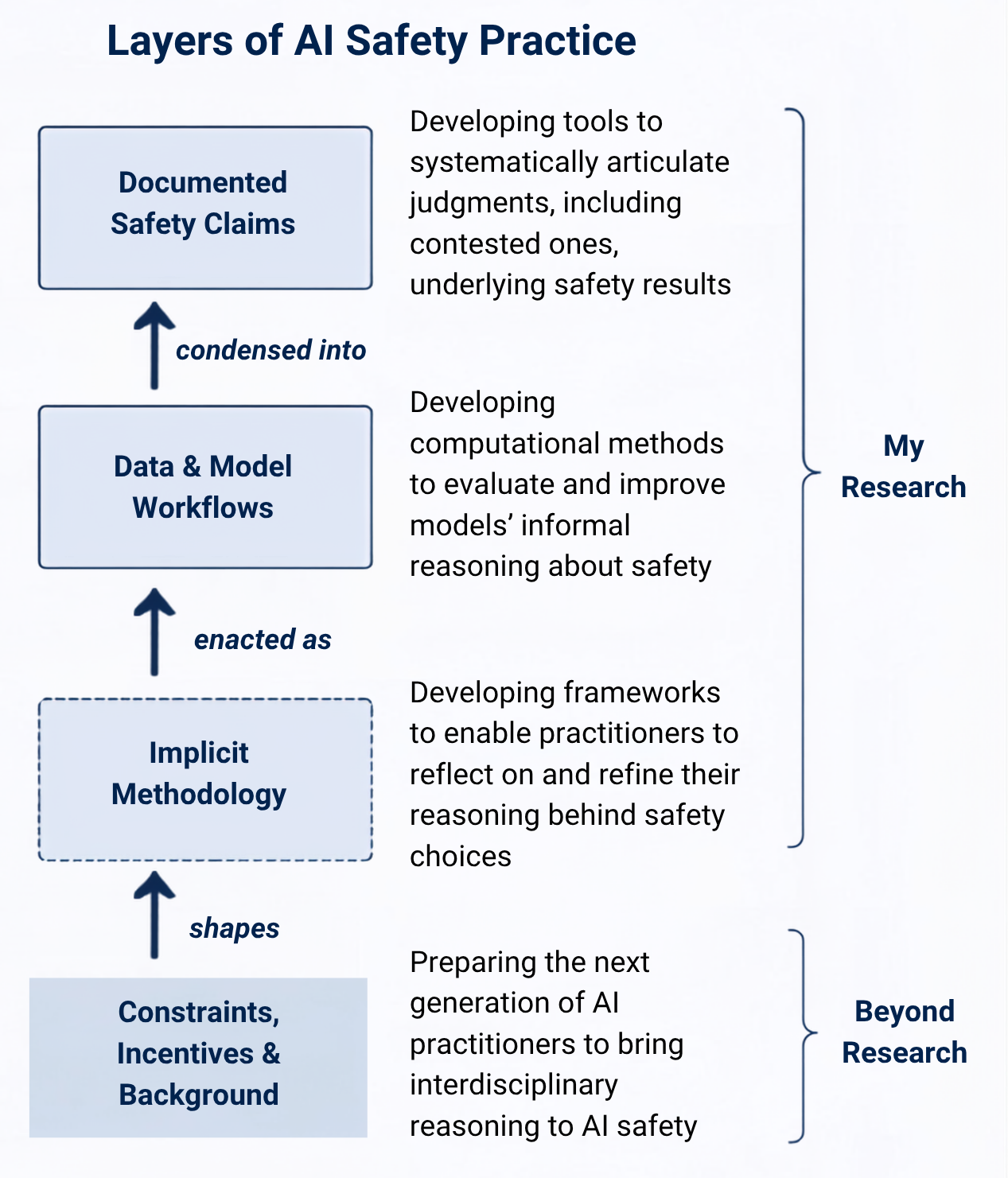
My Research. I study AI safety through the lens of the people who actually build systems with AI models. AI safety is usually treated as something you do to data and models: assemble a dataset, run the model, benchmark the result. But in practice, a system's safety depends heavily on how an AI practitioner frames the problem and works through it—the methodology they bring and the workflows they build on it, much of which stays implicit and rarely recognized as important choices. I unpack this to support practitioners in making AI safety decisions more reflectively and with greater nuance at critical stages of their practice.
Beyond Research. Alongside this, I'm very interested in training the people entering AI practice to approach safety problems through interdisciplinary reasoning—drawing on philosophical, ethical, and sociotechnical lenses—in addition to their technical skills. Reach out to me if you have a unique safety situation or want to try unique approaches to AI safety!
My Approach. My research sits at the intersection of HCI, NLP, and philosophy, and combines two moves:
- Grounding in practice. I draw on user studies of how practitioners actually reason about safety and responsible AI, which keep the frameworks and computational methods I build tied to real practice.
- Grounding in philosophy. Since my questions concern how humans and models reason in a space that is arguably ambiguous, vague, and incomplete, I bring in perspectives new to AI safety, primarily drawn from Informal Logic and Argumentation theories, that let me systematically examine the reasoning in AI safety, which is often presumptive and contestable.
Outcomes. My work produces two complementary outputs, drawing on my grounding in user studies and philosophy.
- The first is reflective frameworks that help practitioners reason about their own reasoning behind safety choices to make better judgments.
- The second is computational methods to evaluate and improve models' reasoning-like behavior and their ability to handle ambiguities in AI safety.
While reflective frameworks let practitioners critically examine their safety choices in practice, the computational methods I develop are aimed at making that reflection actionable, giving them concrete ways to intervene on their data and model workflows. See my publications for the kinds of works I do!